The email looked exactly like the one your biggest funder always sends. Same logo, same warm sign off, a note about updating the account for this quarter’s grant payment. Your bookkeeper followed the instructions, changed the banking details, and moved on. Three weeks later the real funder calls to ask where their money went. By then it’s sitting in an account nobody can trace, and the board wants to know how a mission driven organization with eleven staff just lost forty thousand dollars it did not have to spare.
Stories like that are why cyber insurance for nonprofits has stopped being a nice to have and started showing up on board agendas. Charities hold exactly the kind of data criminals want, donor names, card numbers, sometimes sensitive client records, yet most run on tight budgets and volunteer help. That mix, rich in data and thin on defenses, is the reason attackers keep circling back. This guide walks through what the coverage does, what it costs a nonprofit in 2026, how much you actually need, and why your board may already be on the hook to have it.
Why nonprofits are such easy targets
Security researchers have a blunt phrase for the sector: cyber poor and target rich. Nonprofits collect and store a lot of valuable information, but they rarely have the staff or the tools to guard it the way a bank would. Surveys of the sector keep landing on the same numbers. Roughly 56% of nonprofits do not require multifactor authentication on their online accounts, close to 70% have no written plan for responding to an attack, and a large share do not actively monitor their networks at all. Every one of those gaps is a door left open.
The data itself is the draw. A donor database is a tidy list of names, email addresses, giving histories, and often stored payment details. That sells. Phishing and social engineering remain the most common way in, usually an email that impersonates a funder, a board member, or a payment vendor. Nonprofits have quietly become one of the most targeted sectors online, and email based threats against them jumped more than 35% in the past year.

There is a human factor too. Nonprofit teams are trusting by nature and stretched thin, so a well written fake request slips through more easily than it would at a company with a full time IT department. The attackers know this. They aren’t picking on charities out of malice so much as opportunity, and opportunity is something a lean organization creates without meaning to.
What cyber insurance for nonprofits actually covers
A cyber policy splits into two halves, and it helps to know which is which. First party coverage pays for your own costs after an incident. Third party coverage pays for claims other people bring against you. A single breach usually triggers both at once.
On the first party side, expect help with hiring forensics experts to find out what happened, restoring locked or corrupted systems, covering lost income while you’re down, paying a ransom when there is no other option, and running the breach notification process. That last piece matters more for nonprofits than people expect. If donor or client records are exposed, state laws generally require you to notify every affected person, and often to offer credit monitoring. Doing that for ten thousand donors by hand is expensive and slow, and it’s the policy that pays for it.

Third party coverage steps in when someone sues or a regulator comes calling. That includes legal defense if a donor claims you failed to protect their information, regulatory fines where the law allows them to be insured, and penalties from card networks if payment data was involved. For a fuller breakdown of the two sides, our guide on what cyber insurance covers lays out every category with examples, and the cyber insurance glossary defines the terms you will meet on an application.
One thing worth flagging early: a general liability policy or a directors and officers policy will almost never pay for a data breach. Those are separate coverages, and assuming your existing insurance has you covered is one of the more common and painful mistakes a nonprofit makes.
What cyber insurance for nonprofits costs in 2026
The good news for a budget conscious organization is that this coverage is more affordable than most board members guess. A small nonprofit with modest data can often start a standalone policy near the range a small business pays, and the sector average lands close to $1,740 a year. Larger organizations, or ones holding sensitive client health or financial records, pay more because they carry more risk.
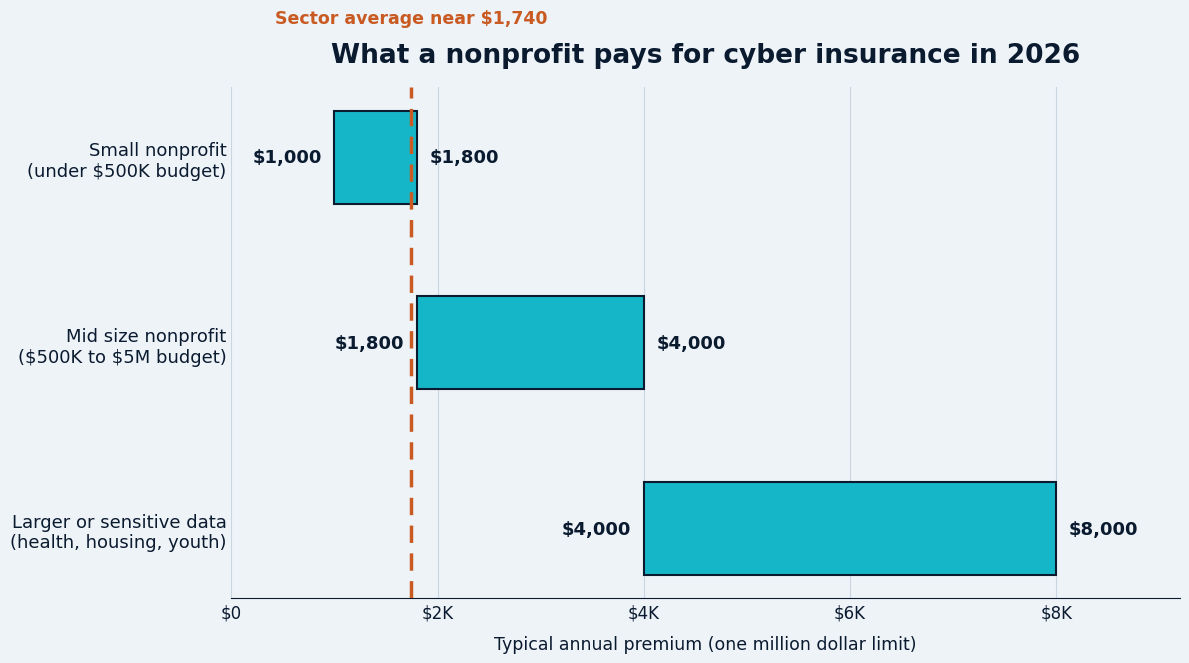
Here’s a realistic picture of what nonprofits pay for a policy with a one million dollar limit, the standard starting point for most groups.
| Nonprofit profile | Typical annual premium | What drives the number |
|---|---|---|
| Small, under $500K budget, limited donor data | $1,000 to $1,800 | Few records, simple systems |
| Mid size, $500K to $5M budget | $1,800 to $4,000 | Larger donor lists, more staff, payment processing |
| Larger or sensitive data (health, housing, youth services) | $4,000 to $8,000+ | Regulated records, higher breach exposure |
Those ranges move with the controls you have in place. A nonprofit that can show multifactor authentication, tested backups, and staff training will be quoted noticeably less than one that cannot, and some applications get declined outright without those basics. If you want to see how price is built across every business type, our breakdown of cyber insurance cost shows the full 2026 ranges, and it is a good place to get a free quote when you are ready to compare.
How much coverage does a nonprofit need?
Most small and mid size nonprofits are well served by a one million dollar limit, which is also where the majority of policies start. The right number really comes down to how many records you hold and how sensitive they are. A local arts group with a few thousand donor emails sits at the low end. A social services agency holding health information or data on vulnerable clients should look higher, often toward two to five million, because a breach there carries heavier notification duties and bigger potential claims.
Run a quick gut check with three questions. How many people’s records would be exposed in a worst case breach? How much would it cost to notify all of them and offer monitoring? Could the organization absorb a six figure loss without cutting programs or staff? If the honest answer to that last one is no, you’re looking at exactly the kind of risk this coverage exists to carry. Our sizing walkthrough for a small business uses the same framework and translates cleanly to a nonprofit.
Your board’s fiduciary duty makes this a governance issue
Here’s the part that surprises a lot of executive directors. Cybersecurity isn’t just an operations problem, it’s a board responsibility. Nonprofit board members owe the organization a duty of care, which means making informed, reasonable decisions to protect its assets. Courts and regulators increasingly treat data protection as part of that duty. A board that ignores obvious cyber risk, skips basic safeguards, or waves off insurance can find itself answering hard questions after a breach.

You don’t need every director to become a security expert. What good governance looks like is straightforward: the board reviews cyber risk at least once a year, confirms that core protections are in place, makes sure there is a response plan, and treats insurance as one deliberate part of the risk strategy rather than an afterthought. Documenting that the board considered and acted on cyber risk is itself a form of protection, both for the organization and for the directors personally. The National Council of Nonprofits offers practical cybersecurity guidance written specifically for the sector.
What insurers will ask you to have in place
Insurers have tightened their standards, and a nonprofit budget is no excuse in their eyes. The reassuring part is that the controls they want are mostly free or low cost, and putting them in place lowers your premium at the same time it lowers your risk. Nearly every insurer now expects to see a short list of basics.

Multifactor authentication on email and any system holding donor data comes first, and missing it is the single most common reason a claim gets denied. After that: reliable, tested backups that are kept separate from your main network so ransomware cannot reach them, up to date software and antivirus on every device, a simple written plan for who does what after an incident, and basic staff training so the person reading that fake grant email knows to slow down and verify. Our full checklist of cyber insurance requirements explains each control and how to document it, and since ransomware is where these controls matter most, it’s worth understanding how that coverage works too.
Key takeaways
Nonprofits are targeted precisely because they hold valuable data and often lack strong defenses, so the risk is real even for small organizations. Cyber insurance for nonprofits covers both your own recovery costs and claims from donors or regulators, including the expensive job of notifying everyone whose records were exposed. Most groups can get solid coverage for roughly $1,000 to $4,000 a year, with a one million dollar limit as a sensible starting point. Because protecting the organization’s data falls under the board’s duty of care, treating cyber risk and insurance as a governance decision is both smart and increasingly expected. And the security controls insurers require, led by multifactor authentication, are mostly free and cut your premium while they cut your risk.
Frequently asked questions
Do small nonprofits really need cyber insurance?
If your organization stores donor information, takes online donations, or relies on email and cloud tools, then yes, the exposure is there regardless of size. Small nonprofits are often targeted more, not less, because attackers expect weaker defenses. A modest policy is usually a few hundred dollars a month at most and covers costs that could otherwise end a small charity.
How much does cyber insurance for nonprofits cost?
Most nonprofits pay somewhere between $1,000 and $4,000 a year, with the sector average near $1,740. Smaller groups with limited data sit at the low end, while organizations holding health records or large donor databases pay more. Having multifactor authentication and backups in place brings the price down.
Will our general liability or D&O policy cover a data breach?
Almost never. General liability and directors and officers coverage are built for different risks and typically exclude cyber incidents. You need a dedicated cyber policy, or a cyber add on, to be protected against a breach.
What does cyber insurance not cover for a nonprofit?
Policies generally exclude losses from known problems you failed to fix, breaches caused by missing required controls like multifactor authentication, and in some states certain regulatory fines. Reading the exclusions and sublimits before you buy is important, which is why comparing quotes carefully pays off.
Is the board responsible if our nonprofit gets breached?
Board members have a duty of care that increasingly includes overseeing cyber risk. A board that reviews the risk, confirms basic protections, and makes a deliberate decision about insurance is meeting that duty. One that ignores clear warning signs can face questions about whether it acted responsibly.