Two bakeries on the same street can pay wildly different prices for the same kind of cyber policy. One owner writes a check for about a thousand dollars a year. The shop two doors down pays four times that for coverage that looks nearly identical on paper. That gap leaves a lot of owners guessing about what a normal price even is, and whether they are getting fleeced.
Here is the reassuring part. For most small businesses, the real numbers are lower than people expect. The median business with fewer than 250 employees pays around $1,740 a year in 2026, which works out to roughly $145 a month. That figure has actually come down from about $2,100 back in 2024, because insurers competed hard on price for two straight years.
So the average cost of cyber insurance in 2026 is less scary than the headlines suggest. But an average hides a lot. Your own price depends on your size, your industry, how much data you hold, and the security you already have in place. This guide lays out the real 2026 ranges with sources, shows you what moves the number up or down, and gives you a few ways to land under the average.
What the average cost of cyber insurance looks like in 2026
Most small businesses buying a standalone policy with a $1 million limit and a $2,500 deductible land somewhere between $1,000 and $2,500 a year. The often quoted median sits near $1,740, and a lot of solo operators and low risk shops come in under that.
Averages published across the market cluster in the same neighborhood. Business insurance marketplaces put the typical small business premium at about $129 to $145 a month. A common standalone $1 million policy runs close to $140 a month. Once you widen the lens to every kind of small business, the full spread runs from around $400 a year on the low end to well over $8,000 for higher risk operations.
A few plain reference points for 2026:
- Median premium, business under 250 staff: about $1,740 a year
- Typical range for a $1 million policy: $1,000 to $2,500 a year
- Common monthly figure: roughly $130 to $145
- Standard deductible: near $2,500
- Full market spread: about $400 to more than $8,000 a year
If you want the deeper breakdown of what shapes a single quote, our full cyber insurance cost guide walks through it piece by piece. For this article, the goal is the bird’s eye view: what businesses like yours actually pay.
Average cost by business size
Size is the first thing an underwriter looks at, because a bigger business has more employees clicking links, more revenue to lose during downtime, and more records to expose. The table below shows typical annual premiums for a $1 million policy in 2026. Treat these as starting ranges, not quotes.
| Business size | Typical annual premium ($1M limit) |
|---|---|
| Solo or under 10 employees, low revenue | $500 to $1,500 |
| Small, 10 to 50 employees | $1,000 to $2,500 |
| Growing, 50 to 250 employees | $2,000 to $5,000 |
| Larger, several million in revenue | $5,000 to $10,000 or more |
Notice that the jump is not smooth. A five person design studio and a forty person agency can both sit near the low end if they hold little sensitive data and run clean security. Revenue tends to push the number harder than headcount, since business interruption coverage is tied to what you would lose while you are down.
One person businesses often ask if they even qualify. They do, and they are usually cheap to insure. If that is you, the section on solo coverage in our small business cyber insurance guide is worth a read.
Average cost by industry
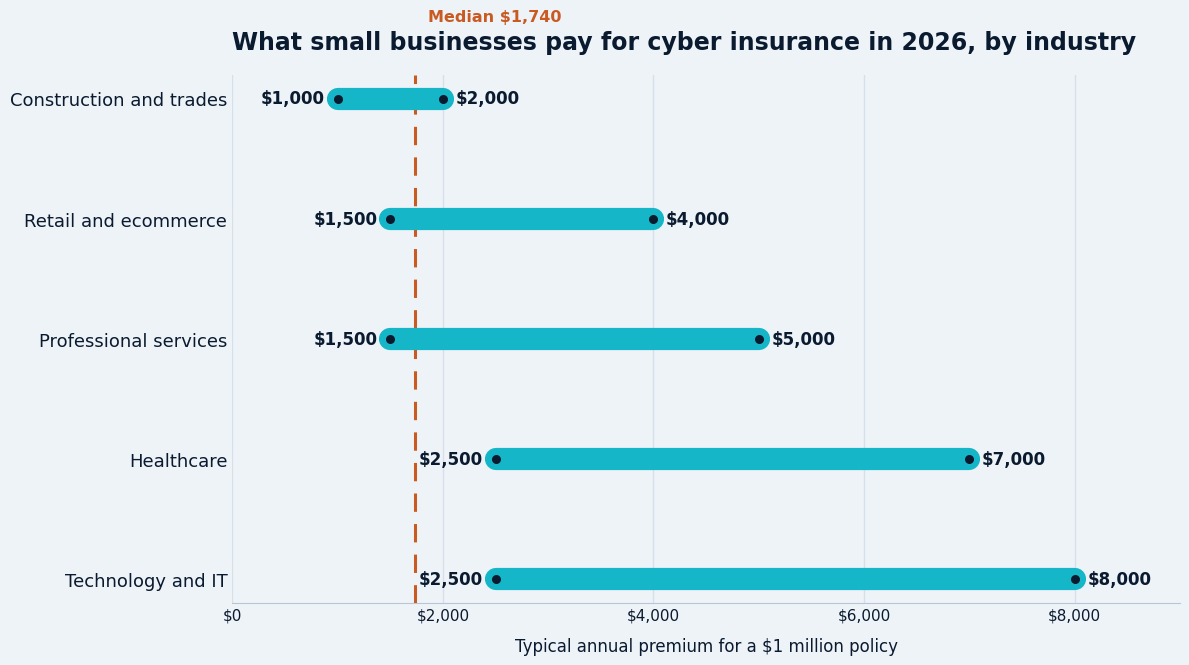
Industry is the other big lever. Insurers price on the kind of data you handle and how often your sector gets hit. A construction firm that stores a few plans and invoices is a very different risk from a medical clinic sitting on thousands of patient records. The ranges below are typical 2026 annual premiums for a small business carrying a $1 million policy.
| Industry | Typical annual premium ($1M limit) |
|---|---|
| Construction and trades | $1,000 to $2,000 |
| Retail and ecommerce | $1,500 to $4,000 |
| Professional services (law, accounting) | $1,500 to $5,000 |
| Healthcare and medical practices | $2,500 to $7,000 |
| Technology and IT services | $2,500 to $8,000 or more |
The pattern holds across the market data. Healthcare practices pay roughly 42% more than the cross industry median because a breach there is expensive and heavily regulated. Technology and IT firms sit highest of all, often near 88% above the typical business, since they hold client systems and are prime ransomware targets. At the other end, recreation and trade businesses tend to pay the least. If you run a clinic, our guide to cyber insurance for healthcare covers why those numbers run high and how to keep them in check.
The average cost of cyber insurance climbs fast once you move from a low data business into a regulated one. That is not a penalty. It reflects what the claim would actually cost if the worst happened.
What makes your premium go up or down
Two businesses of the same size in the same industry can still get very different quotes. Here is what tips the scale.
Revenue and records come first. More money flowing through the business means more to lose during an outage, and more customer records means a bigger notification bill after a breach. Both push the price up.
Your security controls matter just as much, and this is the part you control. Insurers now expect a real security floor, and the single biggest gate is multifactor authentication. Skip it and you will either pay far more or get declined outright. Businesses that document strong controls routinely pay less than a similar shop that cannot. Our cyber insurance requirements guide lists the exact controls insurers want to see.
The limit and deductible you choose move the number too. A higher deductible lowers your premium because you take on more of the small claims yourself. A larger limit raises it. And your claim history counts: a prior breach or a lapsed policy tells the underwriter you are a higher risk than the business next door.
If you want to translate any of these terms, the plain English glossary defines deductible, limit, sublimit, and the rest without the jargon.
Where prices are headed in 2026
Timing matters more than usual right now. The cyber market has been soft for two straight years, and early 2026 marked the eighth consecutive quarter of price cuts. There is plenty of capacity, plenty of insurers competing, and renewals have been landing flat or slightly down. Good news if you are buying today.

That window may be closing. S&P Global Ratings expects cyber rates to climb 15% to 20% later in 2026, as insurers react to claim frequency that rose nearly 40% even while prices fell. Third party claims are trending up too. In plain terms, the discounts of the last two years were not built to last, and owners who lock in now will likely fare better than those who wait until renewals turn.
None of this means rushing into a bad policy. It means that if cyber insurance has been on your list, the current market is friendlier than what is probably coming next.
How to pay less than the average
You can land well under the average cost of cyber insurance without cutting corners on coverage. A few moves do most of the work.
Turn on multifactor authentication everywhere before you apply. It is free or nearly free, and it is the control insurers reward most. Keep isolated backups you have actually tested, run endpoint protection on every device, and write down a simple incident response plan. These are the same steps that make a claim more likely to pay, so they help you twice.
Then shop the market properly. Prices for the same business can vary 20% to 70% between insurers, so get at least three quotes before you sign. Compare the limits and sublimits, not just the monthly price, since a cheap policy with a low social engineering sublimit can leave a painful gap. When you are ready to see real numbers for your business, you can check your coverage and request a free quote and line the offers up side by side.
Raising your deductible a little is another quiet way to trim the premium, as long as you keep enough cash to cover it. And bundling cyber with your other business policies sometimes earns a small discount, though a strong standalone policy usually protects you better.
Key takeaways
- The median small business paid about $1,740 a year for cyber insurance in 2026, near $145 a month, down from $2,100 in 2024.
- Most $1 million policies run $1,000 to $2,500 a year, with the full market spread from about $400 to more than $8,000.
- Size and industry drive the price the most. Healthcare pays around 42% above the median, and technology firms the most of all.
- Strong security, especially multifactor authentication, lowers your premium and helps your claim pay.
- The market is soft today, but rates are expected to rise 15% to 20% later in 2026, so buying sooner has an edge.
Frequently asked questions
What is the average cost of cyber insurance for a small business?
In 2026, the median small business with fewer than 250 employees pays about $1,740 a year, or roughly $145 a month, for a policy with a $1 million limit. Most fall between $1,000 and $2,500, though prices range from around $400 to well over $8,000 depending on size and industry.
Why is my quote higher than the average?
Usually it comes down to your industry, your revenue, the amount of sensitive data you hold, or missing security controls. Regulated fields like healthcare and high risk fields like technology pay more. If you do not have multifactor authentication in place, expect a higher price or a declined application.
Is cyber insurance cheaper if I have good security?
Yes. Insurers reward documented controls with lower premiums, and in some cases you cannot get covered at all without them. Multifactor authentication, tested backups, endpoint protection, and a written incident response plan are the ones that move your price the most.
How much does cyber insurance cost per month?
Most small businesses pay somewhere between $85 and $200 a month, with a common figure near $130 to $145 for a $1 million standalone policy. A solo business with clean security can pay less, while a data heavy or regulated business will pay more.
Will cyber insurance prices go up in 2026?
They are expected to. After two years of falling prices, S&P Global Ratings projects rate increases of 15% to 20% later in 2026 as insurers respond to rising claims. Locking in coverage during the current soft market can help you avoid the higher renewals ahead.