
Type “best cyber insurance” into a search box and you’ll get a dozen ranked lists. One puts Chubb at the top. The next crowns Coalition. A third leads with a carrier you’ve never heard of and a big orange button underneath it.
Here’s the trouble with all of them. None of those lists know what your business does, what data you’re sitting on, or which system would bring everything to a stop on a Tuesday morning. They’re ranking brand names. You’re buying a promise to pay.
So the useful way to shop for the best cyber insurance for small business isn’t to memorize a leaderboard. It’s to learn the handful of places where policies quietly differ, then hold every quote you get up against them. It takes about twenty minutes, and it’s the difference between a policy that shows up and one that sends you a letter explaining why it won’t.
Why there’s no single best cyber insurance for small business
Cyber policies look standardized. They aren’t. Two quotes can both say $1 million in coverage, land within $50 of each other on price, and behave nothing alike when something actually goes wrong.
The gap shows up in the claims data. Roughly 21% of cyber claims were denied or only partly paid in 2025, up from about 15% in 2023. The single most common reason wasn’t a weird exclusion or bad luck. It was businesses failing to keep up the security controls they said they had on the application, which accounted for about a third of denials.
That tells you something important. The “best” policy isn’t the one with the glossiest website. It’s the one whose fine print lines up with how your business actually runs, sold by a carrier that will still be around and still answering the phone on your worst day.

If you’re brand new to this, it’s worth reading what cyber insurance covers first, then coming back. The checks below assume you already know the basic shape of a policy.
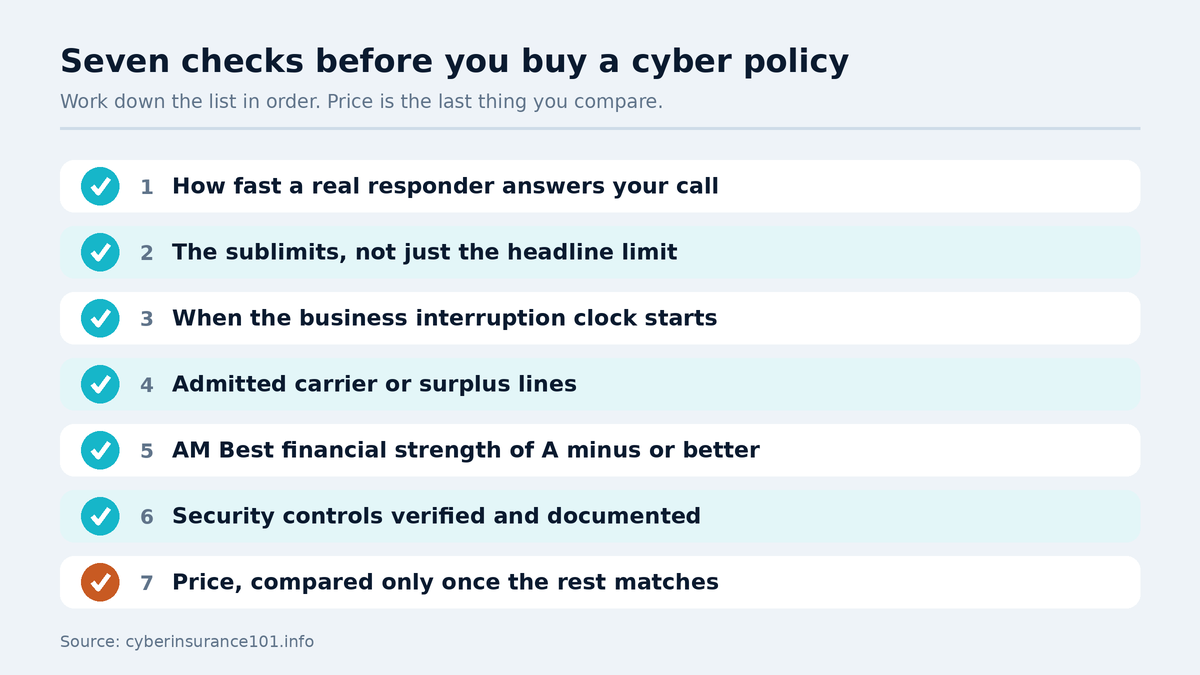
The 7 things to check on any cyber insurance quote
Work through these in order. The first three matter more than price.
1. How fast you can reach a human after an incident
Every cyber policy sells “incident response.” The quality varies enormously. Some carriers staff a genuine 24 hour hotline and have a coordinator on your call within a few hours. Others give you an email address and a vendor list.
This isn’t a soft feature. Allianz reported that cyber claim severity fell by about half in the first half of 2025, and large losses dropped roughly 30%, largely because incidents were being caught and contained faster. Speed is the single biggest lever on how bad a breach gets, and after hour one, that speed belongs to your insurer’s team, not you.
Ask the plain question: if I call at 2am on a Saturday, who picks up, and how long until someone is working my incident? Get the answer in writing.
2. The sublimits, not the headline number
A $1 million policy rarely pays $1 million for everything. Individual buckets carry their own caps, called sublimits. On a typical small business policy you’ll find ransomware, funds transfer fraud, forensics, and breach notification each capped somewhere between $100,000 and $250,000, no matter what the front page says.
That matters because those buckets are exactly where small business claims land. Say a bookkeeper gets tricked into wiring $200,000 to a fake vendor account. Against a $100,000 fraud sublimit, half of that loss is yours. Ask for the sublimit schedule on every quote and compare those numbers, not the headline limit. The glossary spells out how each one works.

3. When the business interruption clock starts
If an attack knocks your systems offline, business interruption coverage replaces the income you lose. But it doesn’t start at minute one. Policies build in a waiting period, commonly eight to twelve hours, and you absorb everything before that.
For a business that can limp along on paper for a day, a twelve hour waiting period is fine. For an ecommerce shop or a clinic running on scheduling software, eight hours versus twelve is real money. Check the number, and check how the policy defines the period of restoration too, because that decides when payments stop.
4. Whether the carrier is admitted in your state
This one almost never appears in comparison articles and it should. Admitted carriers are licensed by your state insurance department, and their claims are backed by the state guaranty fund. If the company fails, the fund steps in and approved claims still get paid.
Surplus lines carriers, sometimes called nonadmitted, write outside that system. They can customize coverage in ways admitted carriers can’t, which is genuinely useful for unusual risks. But no guaranty fund stands behind a surplus lines policy. For a straightforward small business, admitted coverage is usually the safer default, and it’s often available. Just ask which one you’re being offered.
5. The carrier’s financial strength rating
Insurance is only worth what the insurer can pay. AM Best grades carriers from F up to A++, and a rating of A minus or better signals a company with a strong balance sheet and low risk of going under. You can look any carrier up on the AM Best ratings site in about a minute.
If you’re being offered a surplus lines policy, this check does double duty. With no guaranty fund behind it, the rating is the only backstop you have.
6. Whether your real controls match what the application says
This is where most denied claims are born. Insurers now expect specific defenses in place, and they check after a loss. Around 80% require multifactor authentication and roughly 65% require endpoint detection and response. If the application says you have MFA on email and remote access and it turns out one admin account never had it switched on, your claim is in trouble.
Before you sign anything, verify each control is actually live, then keep a dated screenshot or export as proof. Our requirements guide walks through the five controls insurers ask about most and how to document each one. Getting this right also drags your premium down, so it pays twice.
7. The price, judged last
Price only means something once the six checks above are equal. A cheaper quote with half the sublimits and a twelve hour waiting period isn’t cheaper. It’s less coverage with a smaller bill.
When you’re ready to see real numbers for your business, you can get a free quote and compare cost ranges here. Line up at least three, with matching limits and deductibles, or you’re comparing nothing.
The carrier names you’ll run into
Every list of the best cyber insurance for small business circles the same set of companies, and there’s a reason for that. Chubb, Coalition, Hiscox, Travelers, AIG, The Hartford, and Zurich all write small business cyber coverage in the United States, all have real claims operations, and all show up repeatedly in independent rankings.
What those rankings can’t tell you is which one fits you. Chubb tends to be praised for breadth and for scaling from a two person shop upward. Coalition is known for a technology first approach and fast response. Hiscox has the lowest entry point of the group, with basic policies advertised from around $33 a month bought direct, which is attractive if your exposure is small and honestly assessed.
Treat those as starting points for conversations, not verdicts. The same carrier can hand two similar businesses very different policies depending on the underwriter, the state, and how your application reads.
How to score two quotes side by side
Print both quotes and fill this in. Anything you can’t answer is a question for the agent, not a detail to skip.
| What to compare | What a strong answer looks like |
|---|---|
| Aggregate limit | $1 million for most businesses under 250 staff |
| Sublimits on ransomware, fraud, forensics, notification | Named in writing, and high enough to cover a realistic loss |
| Incident response | A 24 hour hotline with a named responder engaged within hours |
| Business interruption waiting period | Eight hours or fewer if downtime hurts you quickly |
| Admitted or surplus lines | Admitted where available, and you know which you have |
| Carrier financial strength | AM Best rating of A minus or better |
| Required controls | Every one on the application verified and documented |
| Deductible and premium | Compared only after everything above matches |
What good coverage costs in 2026
A well built policy for a small business isn’t expensive. The median business under 250 employees pays around $145 a month, or roughly $1,740 a year, for a $1 million limit with a $2,500 deductible. Standalone $1 million policies commonly run $1,000 to $2,500 a year.

One planning note. After several years of falling prices, S&P Global expects cyber rates to climb 15% to 20% during 2026, with the steepest increases aimed at businesses that can’t demonstrate solid controls. If you’re shopping now, locking in while documenting your defenses well is a reasonable move. For a fuller breakdown by size and industry, see our small business cyber insurance guide.
Key takeaways
- There’s no universal best cyber insurance for small business. There’s only the policy whose fine print matches your risk.
- Check incident response speed, sublimits, and the business interruption waiting period before you look at price.
- Ask whether the carrier is admitted in your state and what its AM Best rating is. A minus or better is the bar.
- Most denied claims trace back to security controls that were promised but not maintained. Verify yours and keep proof.
- Get three quotes with identical limits and deductibles, then compare. Expect prices to firm up through 2026.
Frequently asked questions
Which company is the best cyber insurance for a small business?
No single company wins for everyone. Chubb, Coalition, Hiscox, Travelers, AIG, The Hartford, and Zurich are all credible options that write small business cyber coverage. Which one is best for you depends on your industry, the data you hold, your state, and how your controls look on the application. Compare the policies, not the logos.
Is a very cheap cyber policy ever worth buying?
Sometimes, yes. A $30 a month policy on a one person business with almost no stored customer data can be a sensible floor. It stops being sensible the moment you take card payments, hold personal records, or would lose real income from a few days of downtime. At that point the sublimits on a bargain policy are usually too small to matter much.
Should I buy through my current business insurance agent?
It’s a fine place to start, especially if they write cyber regularly and can explain the sublimits without reading from a brochure. Just don’t stop there. Get at least one quote from a carrier that specializes in cyber, because specialists often have sharper incident response and clearer policy language.
Is a higher limit better than better coverage?
Usually not. Doubling a $1 million limit to $2 million does nothing for you if the ransomware sublimit stays at $100,000. Fix the sublimits and the response terms first, then consider a bigger aggregate limit if your revenue or contracts call for it. Our ransomware coverage guide shows why that bucket matters so much.
How often should I reshop my policy?
Once a year at renewal, and immediately after anything that changes your risk: new employees, a move to a new cloud platform, a new line of business, or a client contract that sets its own insurance minimums. Rates and required controls are both shifting in 2026, so an annual look is worth the hour.